Friday, September 26, 2008

Hubert Chang Claims He Co-Designed Google

Who is Hubert Chang and what does he have to do with Google? Chang has emerged from obscurity this week with the audacious claim that he helped launch the search giant in 1997 along with acknowledged co-founders Sergey Brin and Larry Page.

Chang posted his story on the video sharing site Vimeo and it was picked up by the Web site Weberence. It spread virally from there, even to YouTube, a Google (NASDAQ: GOOG) property.

But far from adding another legitimate chapter to Google's storied history, the video leaves many questions unanswered.


Update: Here is Google’s comment:

There is no substance to Hubert Chang’s claims – he had no involvement in the creation of Google. Neither Larry or Sergey have any recollection of meeting him – however, given the number of people they’ve met in the last decade it’s impossible to say categorically that they never have. Rajeev Motwani, the Professor and Director of Graduate Studies at Stanford, believes he may have shared some emails from Mr Chang with Larry and Sergey in 1997 or 1998. But in any case PageRank had already been developed by that time and was a working prototype.

Also, Valleywag points to an archived page of Hubert’s homepage which indicates that either he believes he had influence in a lot more than just Google, or that Hubert’s just pulling pranks. Plus, TechCrunch has a statement by Stanford Professor Rajeev Motwani:

To the best of my knowledge, his claims about being a founder of Google, coming up with the name and/or the business plan etc, are completely unfounded in reality. I am sure I would have noticed a third founder, if one existed, since I was working closely with Larry and Sergey at Stanford the time.

I do recall receiving a couple of emails from Hubert Chang in 1997 or 1998. Its been such a long time that I don’t have any recollection of their contents but it’s probable I shared those emails with Larry and Sergey. In any case, by that time the basic idea of PageRank was already in place and there was a clear intent of building a company around this. I am pretty certain that none of the three of us actually met with Hubert Chang during that time period

Chrome fades as users return to IE, Firefox

Google browser's share slips, IE and Firefox reverse the erosion, Safari still immune

Chrome's share of the browser market is fading as users who abandoned Internet Explorer and Firefox start to return, an Internet measurement company said today.

At the end of its third week of availability, Google Inc.'s Chrome accounted for 0.77% of the browsers that visited the 40,000 sites tracked by Net Applications, down from a 0.85% share the week before.

"The trend line on Chrome still has a slight downward angle, and these weekly numbers reflect that," said Vince Vizzaccaro, Net Applications' executive vice president of marketing. Although Chrome popped above 1% within hours of its release, the new browser now reaches that mark only in the middle of the night, U.S. time, Vizzaccaro added.

Chrome's numbers, like those of Mozilla Corp.'s Firefox and Apple Inc.'s Safari, typically climb after work hours and then fall as work resumes the next day. Many businesses standardize on Microsoft Corp.'s Internet Explorer (IE) and don't allow employees to use alternate browsers.

IE and Firefox still showed share erosion compared to the period immediately before Chrome's Sept. 2 debut, but both browsers regained users last week, Vizzaccaro said. IE picked up 0.24 percentage points last week, while Firefox regained 0.06 points. Both, however, remained down for the month, as was Opera Software ASA's Opera and AOL LLC's now-defunct Netscape.

Safari, the only browser to escape Chrome's impact, was still on the plus side for September, ending last week up 0.45 percentage points before Chrome, although that was down from the prior week's 0.68-point net gain.

Last week, Vizzaccaro said Safari's immunity could be traced to the lack of Chrome competition. Although Google has promised a native Mac OS X edition, its browser is currently only available for Windows XP and Windows Vista.

Computerworld's site metrics echoed Net Applications' trend for Chrome. The percentage of visitors to Computerworld.com who used Google's browser dropped to 4.01 points last week, down from 4.96 points.

Chrome's slow slide may be because of Google's low-key promotion, Vizzaccaro said. "The only marketing effort I've seen from Google is in sponsored links on search results for 'browser' or 'browsers' search terms," he said. "On Google, Chrome is naturally the top sponsored link. On Yahoo, it was second. And on Windows Live, I couldn't even find it in the first five pages of organic results."

Week starting Aug. 24 Aug. 31 Sept. 7 Sept. 15 Net Change
IE 72.39% 71.03% 71.24% 71.48% -0.91%
Firefox 19.54% 19.78% 19.35% 19.42% -0.13%
Safari 6.27% 6.67% 6.95% 6.73% 0.45%
Chrome ----- 0.67% 0.85% 0.77% 0.77%
Opera 0.74% 0.75% 0.70% 0.68% -0.06%
Netscape 0.77% 0.83% 0.67% 0.66% -0.11%

Source: Net Applications, Computerworld


LHC Dooms day delayed


CERN announces that needed repairs, plus high fuel costs, will delay the first planned collisions until next spring

Efforts to begin operation of the Large Hadron Collider, set to become the world’s most powerful atom smasher, have suffered a major setback. A faulty electrical connection and helium leak in a section of the collider's 27-kilometer-long tunnel have forced the accelerator into an early — and prolonged — winter hibernation.

CERN announced September 23 that the collider will be shut down until next spring. Repairing the section will take an estimated three to four weeks because it will require a warm-up to room temperature. By the time engineers could cool the section back down to 1.9 degrees above absolute zero, little time would remain to operate before the LHC’s scheduled winter shutdown. (Fuel costs make running the LHC during winter too expensive.)

“The time necessary for the investigation and repairs precludes a restart before CERN’s obligatory winter maintenance period, bringing the date for restart of the accelerator complex to early spring 2009,” according to a CERN press release. “LHC beams will then follow.”

The collider’s tunnel hosts several superconducting magnets. On September 19, a faulty electrical connection between two of these giant magnets in one section of the tunnel led to a major leak of helium, the LHC’s main coolant. Engineers will have to warm up the section in order to repair it.

Before this setback, CERN had intended to have the first collisions between two beams in October. These first beams would each have had an energy of 5 trillion electronvolts — five times more energetic than those any other collider has managed. On September 10, scientists successfully sent a proton beam around the entire tunnel.

The plan had been to host this first collision before shutting down the LHC in December for four months.

When the accelerator does run at full capacity, each proton beam will carry seven times more energy and have about 30 times the intensity of any beam at any other accelerator.

The most intense collisions will generate the heat, energy and densities that existed just a trillionth of a second after the Big Bang.

Physicists hope that the LHC will lead them beyond the standard model of particle physics and to signs of extra dimensions, new types of elementary particles that could account for most of the mass in the universe and, perhaps, rapidly evaporating, microscopic black holes that the accelerator may forge.

ok... You can start singing "I will survive...."

Tuesday, September 23, 2008

Google’s G1: First Impressions

Google’s new G1 phone announced today is the first real competitor to the iPhone. Like Apple’s product, it’s a serious handheld computer with a powerful new operating system (called Android) and a clever touch-based user interface. Like the iPhone, it’s likely to be a major new platform for third-party software. But it’s also very different, and may appeal to different buyers.

The phone, expected to be the first of many to use the Android operating system, was largely designed by Google, and was built by HTC of Taiwan. It will be sold in the U.S. starting next month by T-Mobile, for $179 with a two-year contract.

Here are some first impressions of the G1, based on some experience with a prototype. This isn’t a full review; that will come later, when I’ve had a chance to use a more finished device.

Most importantly, the G1 complements its touch screen with a physical keyboard, the lack of which has made the iPhone a non-starter for some users. The G1’s keyboard is revealed when you slide open its screen. The keys are a bit flat, and you have to reach your right thumb around a bulging portion of the phone’s body to type, but it’s a real keyboard. And there’s also a BlackBerry-like trackball that supplements the touch screen navigation. I found typing on this keyboard to be OK, but not great.

A second big feature, or limitation, of the G1 — depending on your point of view — is that it is tightly tied to Google’s web-based email, contacts and calendar programs. In fact, you must have a Google (GOOG) account to use the phone, and can only synchronize the phone’s calendar and address book with Google online services. Unlike the iPhone, it doesn’t work with Microsoft Exchange, and it can’t physically be synced with a PC-based calendar or contacts program, like Microsoft Outlook.

So, if your world already revolves around Google services, you may find that the G1 fits like a glove. If not, you may be disappointed.

Also, like the iPhone, the G1 has a download service for third-party programs, called Market. I downloaded a couple of simple Market programs and they worked fine.

The G1 won’t win any beauty contests with its Apple (AAPL) rival. It’s stubby and chunky, nearly 30% thicker and almost 20% heavier than the iPhone. It’s a bit narrower — more like a standard phone than a “smart phone” — and longer, but has a somewhat smaller screen.

Still, it feels pretty good in the hand when closed, although I found it more awkward when opened.

But the software is slick. Programs appear in a virtual drawer you slide open via a tab at the bottom of the screen, and notifications of new messages and the like can be read by sliding the top bar of the screen down. The screen and software were quick and responsive.

The web browser is based on the same open-source technology as the iPhone’s, but works differently. You can view a portion of a page, and use a zoom control and finger-dragging to see the rest, or you can view the whole page in miniature, as on the iPhone. In the latter mode, however, you can’t simply use Apple’s technique of tapping or “pinching” to zoom in on a portion of a page. You must move around a virtual lens to pick out a part of the page on which to focus.

There are two email programs: one for Google’s Gmail, another for all other email services. There’s an instant messaging program, that works with multiple services — not just Google’s. And, as on the iPhone, there are programs for using Google Maps and Google’s YouTube video service. The G1’s Google Maps program has a feature lacking in the iPhone version: photographic street views of some locations.

The G1 has a couple of other things the iPhone omits: copy and paste functionality and a so-called MMS program, which sends photos to other phones without using email. Its camera is higher-resolution than the iPhone’s, but, like Apple’s, doesn’t record video.

It also gives you far more flexibility in organizing your desktop, or home screen, than the iPhone, or almost any phone I’ve seen. In addition to placing icons for programs there, you can place everything from individual contacts, music playlists, folders, web pages, and more.

The G1’s multimedia capabilities are less polished and complete than the iPhone’s. There’s a very basic music player, and a built-in version of Amazon’s MP3 download service that works fine. But the G1 lacks a built-in video player — you have to download one from the third-party software store. Also, you cannot use standard stereo headphones with the G1. You need special ones, or an adapter.

And it lacks the iPhone’s ability to change the orientation of a web page or photo by just turning the phone. You also can’t move through groups of photos by just “flicking,” as on the iPhone.

The G1 also has much less memory than the iPhone. The base $199 iPhone comes with 8 gigabytes sealed in, but the G1 comes with just a 1 gigabyte memory card. Its maximum memory, if you buy a bigger card, is 8 gigabytes, while the iPhone can be purchased (for $299) with twice that.

T-Mobile is claiming similar talk time to that of the iPhone, but, unlike Apple’s product, the G1 has a removable battery.

Finally, a word about networks. In the U.S., the G1 will initially only be available on T-Mobile, whose high-speed 3G network will be up and running in many fewer cities than those of its larger rivals, AT&T (T) and Verizon (VZ). Like the iPhone, the G1 does have Wi-Fi, Bluetooth and GPS.

In sum, the G1 is a powerful, versatile device which will offer users a real alternative in the new handheld computing category the iPhone has occupied alone.

Friday, September 19, 2008

Google extends African reach

Search giant extends African home pages and releases new East African Google Gadgets.

Search engine giant Google now has 26 customised country home pages in Africa. The most recent of these is the homepage for Mozambique (www.google.co.mz).

The Mozambique homepage is also Google's third for Portuguese-speaking countries in Africa - the others being Angola and São Tomé and Príncipe.

Meanwhile, Google has also announced the winners of its recent competition for East Africa-based Google Gadget developers. The six-month long competition was aimed at encouraging East African developers to create Google Gadgets relevant to their countries.

The overall winner of the competition was Antoine Nzeyimana of Rwanda who created an Igisoro Game, a numbers game played widely in Rwanda.

Other winners in the competition included charting applications, a random proverb application and tools for deaf users.

A full list of winners can be found at http://www.google.com/intl/en/events/eagadgetcompetition

Thursday, September 18, 2008

New Windows Live Betas

With the Windows Live Wave 3 beta due to start today, we thought we’d provide our readers with a small headstart on the rest of the world. Here’s the download links for the new Wave 3 suite of applications, including Messenger v9, Windows Live Movie Maker, Mail with Calendar synchronisation, Writer, Photo Gallery, Family Safety and the Outlook Connector. For the paranoid amongst you, yes the files are hosted on download.microsoft.com.

http://tinyurl.com/liveside-wlwave3web (only downloads the applications you select)

image

http://tinyurl.com/liveside-wlwave3all (downloads all the applications, you can chose which ones to install)

image

You can see the full list here

Saturday, September 13, 2008

What Can IT Learn From The Large Hadron Collider?


IT solution providers believe the LHC has the potential to not only usher the physics community into a new era, but to also eventually have beneficial effects on the pace of IT industry advancement.

"It may only require the confirmation of a single, basic aspect of our understanding of the universe to unlock a broad group of elusive mysteries," said Joe Bardwell, president and chief scientist of Connect802, a solution provider in San Ramon, Calif.

The LHC is an example of fundamental research that's crucial to driving technology forward, and it couldn't come a minute too soon, according to Dale Mitchell, general manager of Data Processing Sciences, a Cincinnati, Ohio-based solution provider.

"Sub-atomic research is vital to continued technology development. The only other research as important in my mind is biotech," said Mitchell. "Until we, as a society, can find a way to break the speed of light, we've about reached our limit in travel and computing."

Marc Harrison, president of Silicon East, a solution provider in Manalapan, N.J., says what physicists are doing today will affect the semiconductor fabrication process in 10 to 20 years.

"Without a doubt, the increased understanding of particle physics gained through the LHC will lead to technology spin-offs that will affect our industry in years to come," Harrison said.

Friday, September 12, 2008

Welcome to My New Blog

Hi Guys... Here We go again ;)

PS: Smells Like fresh paint.

Tuesday, September 9, 2008

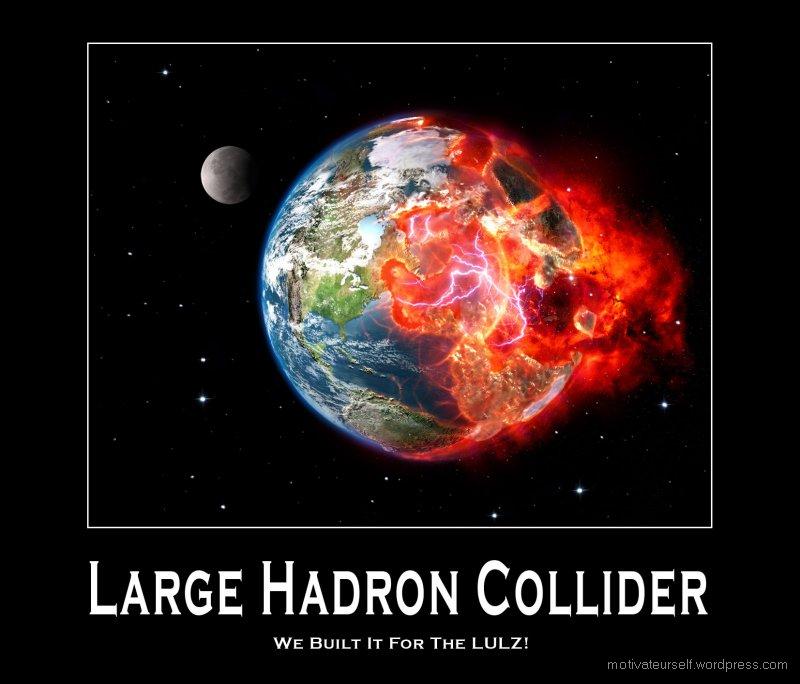
The Large Hadron Collider Will Not Destroy the World Tomorrow, or Ever


You'd better read this today, because it's possible the world will end tomorrow. Strictly speaking, the probability of doomsday isn't any higher than it is on any normal Wednesday, but there's been a fair bit of kerfuffle and hullabaloo over the CERN Large Hadron Collider (LHC) and whether it will create a black hole that will destroy the entire planet. There's even been a rap written about it.

Now, more skilled scientific minds than mine have debunked these doomsayers, but the stories are out there, and kids are bound to hear them. They're bound to have questions, including wanting to know what a hadron is, why scientists want to smash them together, and, by the way, are these European scientists about to suck the world into a black hole? Well, if they've taken high school chemistry, they've probably learned about protons and neutrons, so you can explain that both of those are in fact types of hadrons. You probably don't want to get into their valence quarks, unless you really understand quantum physics and don't mind your kids tuning you out. As for why they're doing it, it boils down to the search for the Higgs boson, also called the "God Particle," which is the only elementary particle that has never been observed by science. If your kids ask why that's so important, point out that it was nuclear research that led to the creation of the Internet, and they may just finally understand why science is so important! If they're also interested in how the LHC works, point them to this explanation on HowStuffWorks.

Now, the other question is a bit tougher, because you (I assume) don't want to outright lie to your kids, but you don't want to alarm them, either. It is actually possible, as I understand it, that the experiment will create subatomic black holes that will last a tiny fraction of a second before collapsing. But the likelihood of these black holes becoming the more well-known kind of black hole is nearly nonexistent.

That being said, if you've raised your kids in the proper GeekDad fashion, they'll have read a lot of science fiction by the time they hit high school. And sci-fi is, of course, full of stories about scientists with good intentions going too far and causing horrible consequences. So it's entirely understandable if your kids are a bit concerned about what's going on on the border between Switzerland and France.

My advice? Just tell them that there's really no chance at all that the world will end in the wee hours of the morning tomorrow. Seriously, how many times can you tell your kids something about the future without even the slightest worry you'll be proved wrong? If you tell them that and you're wrong, I guarantee your kids will never confront you about it.

OK, that may not have been as reassuring as I'd intended. Sorry about that. Seriously, unless every preeminent physicist in the world is very wrong, the LHC is perfectly safe. That's good enough for me.

Source: BlogWired